Multi-access Edge Computing (MEC) and its important role in 5G implementations
Multi-access Edge Computing (MEC) and its important role in 5G implementations
Multi-access Edge Computing (MEC), or formerly known as Mobile Edge Computing, is a term given by ETSI, the European Telecommunication Standards Institute, when referring to the cloud-computing capabilities offered at the edge of the network. The term was changed in September 2017, in order “to embrace the challenges in the second phase of work and better reflect non-cellular operators’ requirements” [1]. MEC is responsible to deliver computing, storage and networking resources to the end user (UE), similar to the cloud computing paradigm. UEs can benefit from ultra-low latency (e.g., 1ms) and high bandwidth (e.g., 10Gbps), but also increased reliability and security [2], since the “cloud” is deployed at the edge of the network, in the UE proximity. 5G applications that could benefit from MEC adoption can be divided into 3 categories [1]:
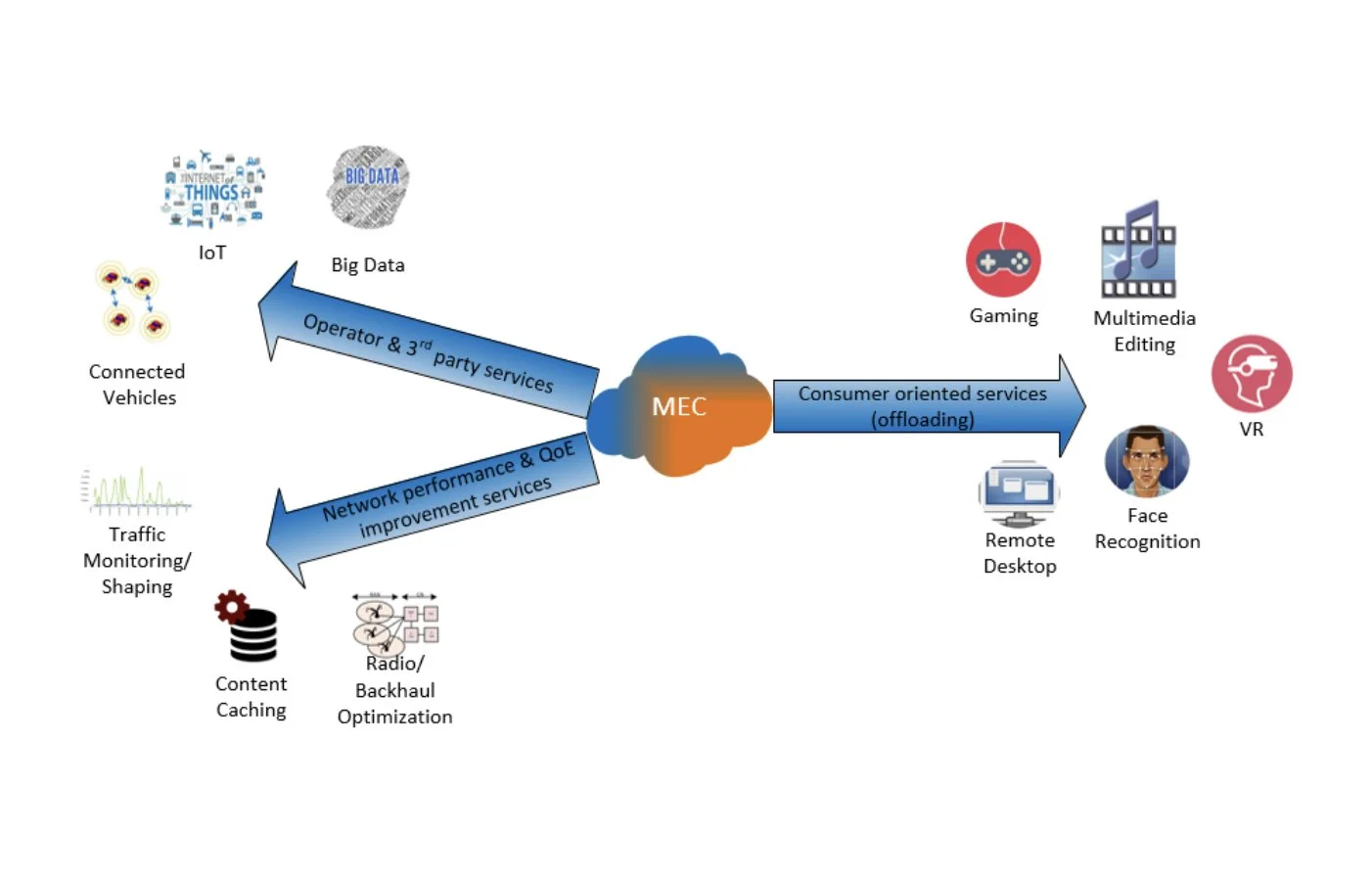
Operator and 3rd party services, that include services that operators and 3rd parties can benefit from by gathering and analyzing big data, data aggregated from Internet of Things (IoT) devices, sensor farms, or even vehicular networks.
Network performance & Quality of Experience improvement services that aid in the smart optimization and allocation of the networking and computing resources across the network, exploiting real-time data.
Consumer oriented services that are beneficial directly to the UEs, including computational offloading, real-time applications that are environment-aware for augmented or virtual reality (VR) and low latency applications such as online gaming.
Figure 1 [3] depicts some of the applications for each category with common factor the requirements for ultra-low latency and guaranteed Quality of Service/Experience. MEC is able to guarantee such real-time operations by minimizing network congestion and improving resource optimization, due to the fact that most of the operations are now able to be executed at the edge of the network, with minimum interaction with the core. Consequently, MEC constitutes a major player towards the 5G realization.
[1] https://www.etsi.org/images/files/ETSInewsletter/etsinewsletter-issue2-2017.pdf
[2] https://www.etsi.org/technologies-clusters/technologies/multi-access-edge-computing
[3] Taleb, K. Samdanis, B. Mada, H. Flinck, S. Dutta and D. Sabella, "On Multi-Access Edge Computing: A Survey of the Emerging 5G Network Edge Cloud Architecture and Orchestration," in IEEE Communications Surveys & Tutorials, vol. 19, no. 3, pp. 1657-1681, 2017
